Underland by Robert Macfarlane: A Book Review
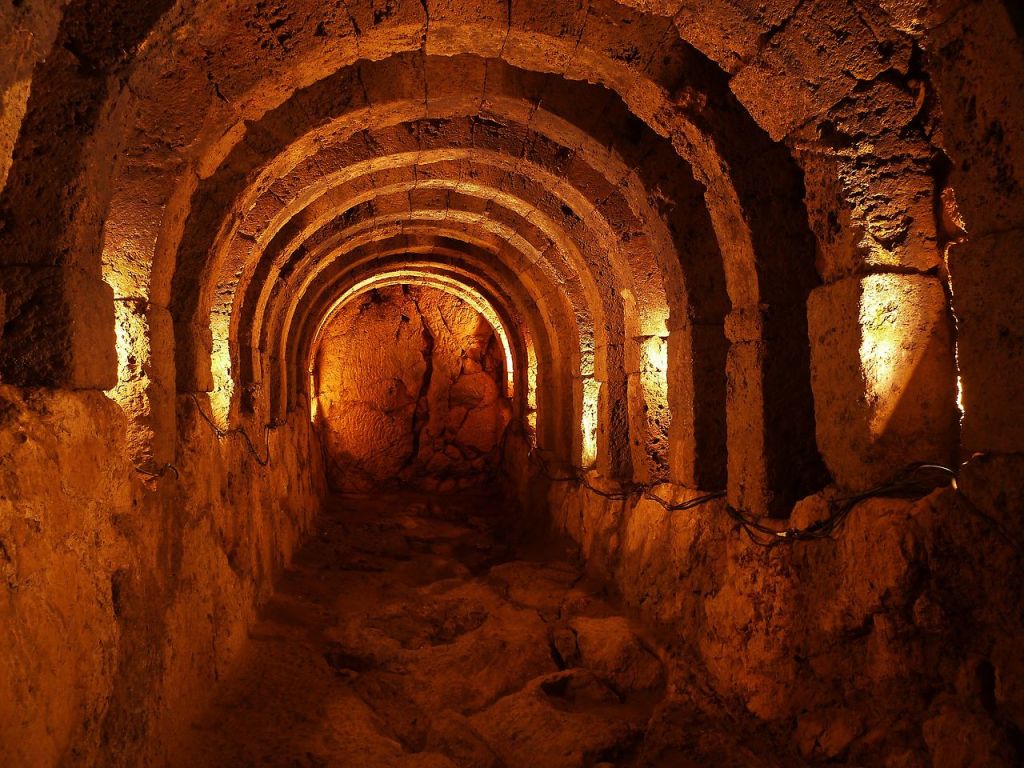
My entrance to the underworld involves a steep steel staircase. It is narrow, and you must be diligent in your descent. Leaving the light and exhaling into darkness, you are greeted with an open rectangular space of stone and shadow. The arched ceiling draws your eye away from the pockmarked ground that requires careful footing, should you care to cross it. But even as you enter, the space ends. It is closed off with a large stone wall – not bricked, but whole – and you can’t help but feel as if this space is supposed to go further. Perhaps this stone is a mercy. Perhaps it is here to save you.
After my trip in 2018 to the Necromanteion in Greece, I thought all entrances to the underworld – to death and the afterlife – could only look like this. Foreboding, isolating, haunting. Now that I’ve read Robert Macfarlane’s Underland, I know better. You see, the underlands are waiting. And they’re pouring over with colour.
While some of Macfarlane’s destinations are passages to and of death, not all are afterworlds. These are places of deep time, in which “[t]he world becomes eerily various and vibrant again. Ice breathes. Rock has tides. Mountains ebb and flow. Stone pulses.” Before I had gone to look up that quote, “vibrant” was actually the word I chose to best describe Underland. “Vibrant” on its own sounds dangerously close to the clipped, one-word reviews that so often plaster book covers, but rest assured I use it here with care.
Certainly, the Paris catacombs or sites of millennium-old cave paintings fit my previous notion of an underland, but Macfarlane brings us even further afield by pointing to our own backyard: the vast mycelium network stretching under each square foot of forest floor. And then, farther, to the sinkholes of the foibe massacres in Italy and Yugoslavia, the vast glaciers of Greenland. As an experienced nature writer and climber, Macfarlane is able to both research and scale these landscapes. Rather than merely describe them, Macfarlane etches the resonances of these places, these moments, and more than a few sentences had me close my eyes, feel the goosebumps raise on my arms, and revel in their unravelling.
I have a great respect for Macfarlane’s decision to not dumb down his terminology, but admittedly I could have used some more explanation on climbing terms. Still, the utmost goal of this book was the flow of language and memory to convey these spaces, as well as showcase the people intertwined with them, which it most certainly succeeded on.
Underland is a vibrant exploration of landscapes left so often unseen. This book is simultaneously immediate and infinitely stretching, flowing over the slow space of language to arrive, eventually, before its reader. Underland is for lovers of nature, adventurous souls, and those drawn to the stranger edges of the world. It is bound to be one of my top non-fiction picks of this year. I am very glad it was my first book of 2025, and the first for me to try my hand at some more highly crafted reviews.

 icarusirving.com